The Ten-Minute Warning

The Door
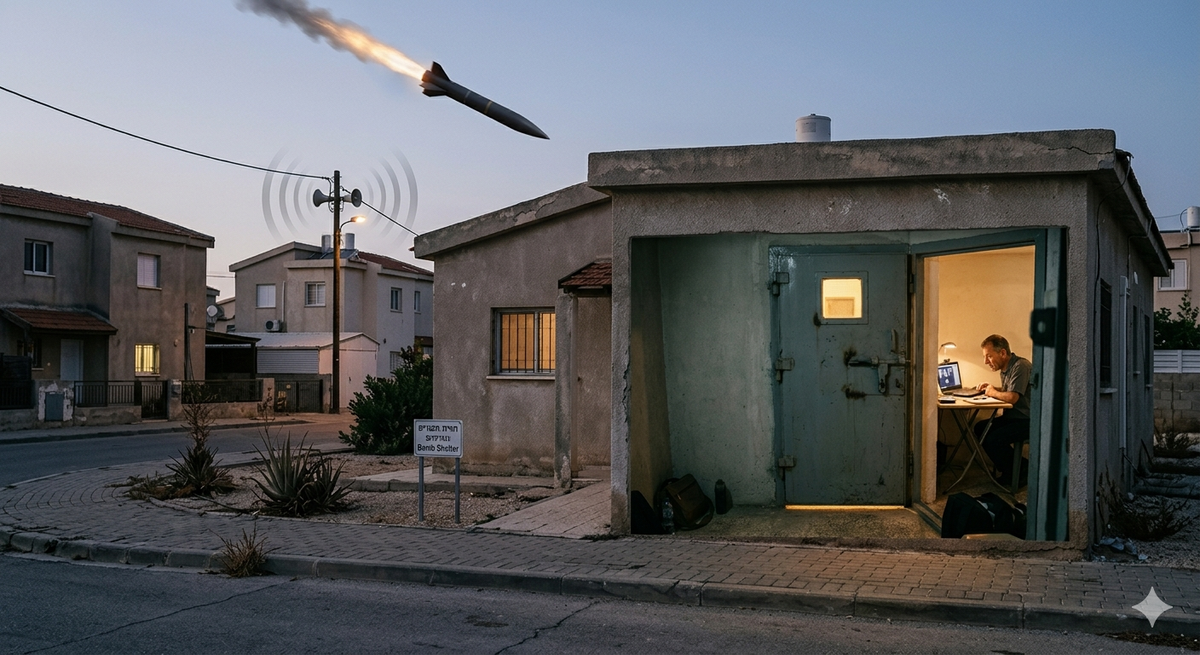
I was in the middle of a session with a client when an alarm went off on his phone. I knew he was in the middle of a war zone, so I asked him, “Do you need to go?” He glanced at his phone and said, "Don't worry, I have ten minutes."
I didn't know what that meant exactly, but I was confident he knew what to do, so we started again. Then, maybe a minute later, a second siren went off and before I knew it he was up and moving — and he was taking me with him.
He entered a room and set the computer on the table, and I watched as he closed the door and I heard him say: “There, I’m safe.” He had just locked himself in the bomb shelter.
That's when he told me that the first alarm means a missile has been launched from Iran. They know it is coming — they just don't know where it will land, so you have time. The second alarm means the missile will hit in your area, take cover. He had described his reality as casually as someone might say they needed to grab a cup of coffee. To him, this wasn’t an interruption. It was just life.
What Stress Looks Like When It Has Been There Too Long
Later in the session, he mentioned that he was having trouble recalling vocabulary he had learned years earlier. When I asked if he was stressed, he said no. And I believe he meant it, so that got me to wondering what was causing his block.
But here is what I found out: when stress lives with you long enough, you stop recognizing it as stress.
The nervous system adapts. It recalibrates. What once would have felt like crisis becomes background noise — because it has to, it has nowhere else to go. Living in a state of alarm is impossible. So the body finds a new normal.
The problem is that the biology does not adapt the same way. Chronic stress keeps cortisol elevated, and cortisol has a direct and well-documented impact on the hippocampus — the region of the brain most responsible for memory. Not just retrieval. Encoding, consolidation, and access are all affected. His brain had been operating under that kind of invisible load for a while.
And he had no idea. None of us do, when we are in the middle of it.
The Freezer
Here is how I like to picture vocabulary and long-term memory.
Think of long-term memory as a freezer. It can store information for years, even decades — but anything left untouched long enough loses its quality and gets freezer burned. The words are still there, but they need time to thaw out.
By actively retrieving vocabulary, we regenerate old neural pathways, or in some cases, create entirely new ones. As the saying goes in neuroscience: neurons that fire together, wire together. But those pathways struggle to stay active when the system is carrying a heavy, invisible load. Neural pathways that go unused do not fire — they go dormant, or in layman’s terms, they go to sleep.
This is not a language problem. It is a retrieval problem, and retrieval can be rebuilt. Oftentimes, we can’t see what others are carrying. Chronic stress. Grief. Years of living on high alert—all of this can become normal, but it does affect our language learning, and our overall health.
The Closed Door
After the siren went off, he returned to the comfort of his couch, and we kept going. He stayed, and he worked. Just like nothing had happened.
I think about the moment he closed that door and said I'm safe — and I think about what it means that he brought his English session with him into that room. That in the middle of everything, language still mattered. He still wanted connection and he still wanted to learn.
So the next time you want to judge someone from another culture, who doesn’t speak your language, who hasn’t had the same luxuries that you have had growing up in America—I want you to think of one thing. Would you be studying English if a missile could be headed straight for your home?
Non-native speakers put in the work, they make sacrifices to learning English, and they even seek safety in bomb shelters in the middle of their sessions in order to learn a language that isn’t their own. That is the commitment and courage that I see from multilingual professionals everyday. I’m proud of them, and inspired by them.
Every non-native professional on the planet deserves to walk into any room, into any organization, and own the room with confidence—because they show up, even during a missile attack.